Paper summary · Sept 2026
Conditional Memory via Scalable Lookup - A New Axis of Sparsity for Large Language Models
- N-gram, the model introduced by DeepSeek in this paper, is a way to produce a trade-off between neural computation and static memory by imbuing the model with a module that modernizes classic n-gram embeddings for lookup.
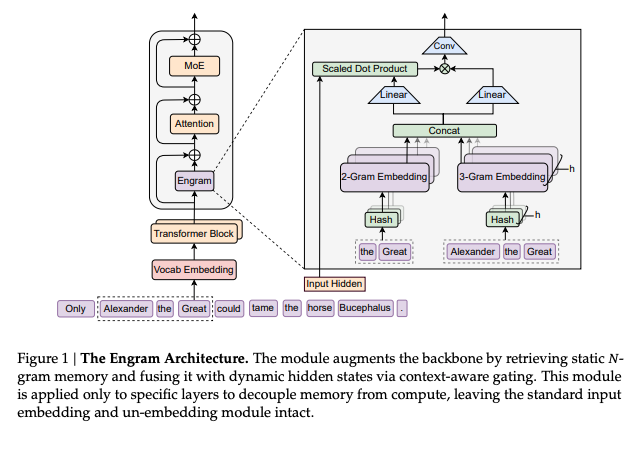
- A visual diagram of the n-gram module and its various components: how it builds and retrieves the known n-grams by utilizing the context as well as the hash table
- the fact that, due to the Zipfian distribution of engrams, the multi-level cache hierarchy is particularly appealing
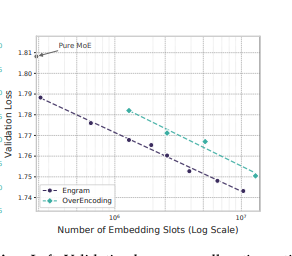
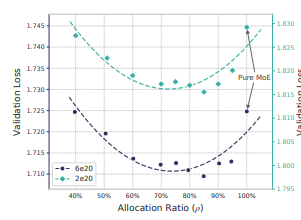
- the scaling laws when we keep iso flop and iso param, as well as when we’re in the infinite memory regime and the log-linear validation loss performance there
- Equation for CKA
- Intuition for what Gram Matrices and HSIC are
Questions
- Explain the XOR hash, how it’s implemented and how it solves combinatorial explosion of possible N-Grams
- what is the expansion rate of 4 in the experimental setup in 4.1 why is the learning rate scaled by 5x with no weight decay for the Engram model? Isn’t this a confounder
- remind me what yarn is and why one needs it for long contexts
- explain the passage on why they changed from base model Isoflav to base model accuracy for the comparison in long context and explain the answers that were observed there
- what are the smoothing techniques commonly applied to Engram
- PatchScope, what is it?
Thoughts
- how well does super BPE or Scone fit in with speculative decoding where 100% coverage isn’t as important compared to overall tokens per second*